The evening, hour by hour
Rome opera arias concert: what to expect
What an evening of opera arias in a small Rome church is like: the room, the voices, the pieces, the manners and the walk from Piazza Venezia.
Reserve seats for the arias ↗Quick answer
Expect about an hour of opera soloists and a grand piano in a small Waldensian church close to Piazza Venezia. The programme moves between famous arias and Neapolitan songs, and the room is small enough that you sit a few feet from the singers. Guests describe warm rooms, soft light and applause that sometimes turns into a standing ovation. Wear what you would for an evening in a church and arrive early.
The hour in outline
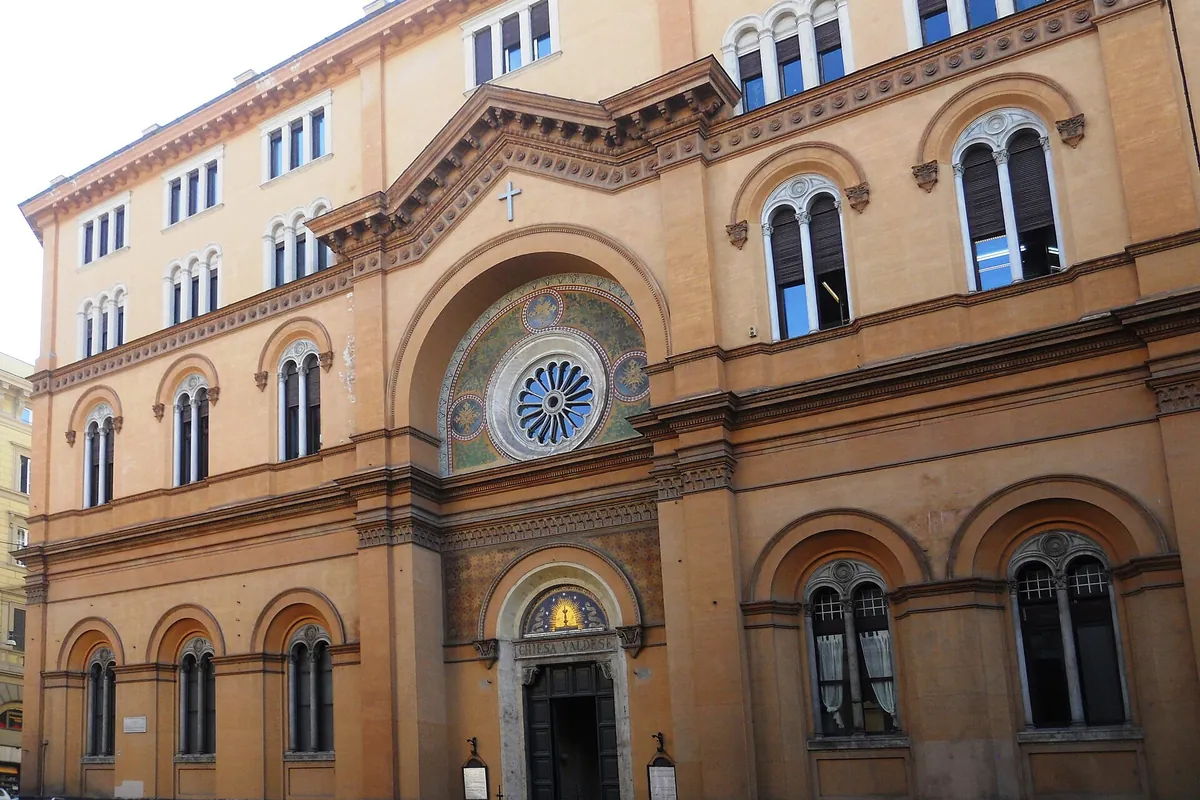
A concert of this kind has a simple shape. You take a seat in a small hall, and a pianist and singers perform a programme that moves between arias and songs. A guest notes that the singers enter and leave by the main door, and another says the whole audience gave a standing ovation. The booking page gives 50 minutes in its details and 70 in its description, so plan on an hour and a little more. Your confirmation shows the start time and the venue, and it is the only reliable source for the evening. Arrive early enough to settle before the music begins. The organiser's dinner programme runs about 70 minutes with one break, so a short pause is possible.
The room: a small Waldensian church
Rome's tourism board describes the Waldensian Evangelical Church on Via Quattro Novembre as a single rectangular room with a coffered ceiling and two rows of mullioned windows, inaugurated in 1884 to a design by Benedetto Pandolfi. The stained glass carries symbols of the Waldensian Church and of the reformed churches of Scotland and the Netherlands, and a pipe organ, opus 698, was built in 1954 by the Carlo Vegezzi Bossi company. The board credits the room with excellent acoustics. The booking page calls the church cosy and says the small space puts you just feet from the musicians. Both descriptions point the same way: a room for listening.
Why a Protestant church hosts opera
The Waldensians are a Protestant church whose origins are traced to Peter Waldo in Lyon around 1173. The movement spread into the Cottian Alps, and in 1848 King Charles Albert of Sardinia granted its members civil rights. After the Reformation it took on Calvinist theology, and in 1975 it united with the Methodist Evangelical Church. The church on Via Quattro Novembre was the first place of worship the Waldensians built in Rome, and the tourism board credits its acoustics for its use as a concert venue. A concert there is a use of the room, not an act of worship, and the booking page describes it as a cosy place to hear an opera programme.
Read next: Rome's Waldensian church, a concert room
Sitting close to the voices
In a small room there is no orchestra pit and no stage between you and the singers, which is the whole appeal. One guest described the evening in glowing terms and advised bringing tissues; another loved the acoustics; a guest from Switzerland called the soprano and the tenor sensationally good. A third found the singers' comings and goings through the main entrance a little distracting. Seats are close to the performers in a room this small, so if you prefer distance and ornament, a theatre will suit you better than a church. If you want an unmediated hour of opera voices, the church delivers exactly that. A guest from the United States praises the pianist as well, and calls the level of all three performers professional.
What an aria is
An aria is a song for a single voice, usually taken from a larger work such as an opera. It expresses a feeling; recitative, which sounds like speech, moves the story. The word is Italian for 'air'. Some arias follow an A–B–A plan, the da capo aria, where the opening returns with elaborate ornament. In 2023 UNESCO put the practice of opera singing in Italy on its list of intangible heritage, describing a controlled technique that increases the carrying power of the voice in acoustic spaces. A church concert makes the idea plain: trained voices filling a hall.
The pieces you may hear
The description names arias from Turandot and Rigoletto, Neapolitan songs and Vivaldi's Four Seasons. The organiser's printed programme for its dinner evening includes Puccini's Nessun dorma and Vissi d'arte and Verdi's La donna è mobile. Nessun dorma is sung by Calaf, a tenor, in Act 3 of Turandot, Puccini's last opera. Vissi d'arte belongs to Tosca, a soprano, in Act 2 of Puccini's Tosca. O mio babbino caro is sung by Lauretta, a soprano, in the one-act comedy Gianni Schicchi. Programmes change by date, so treat any list as a sample of the style. La donna è mobile is sung by the Duke of Mantua, a tenor, in Verdi's Rigoletto, an opera that was first performed at La Fenice in Venice on 11 March 1851.
Neapolitan songs and the encore habit
Neapolitan songs are sung in the Neapolitan language, usually by a male soloist, and many became world-famous through emigrants from southern Italy between roughly 1880 and 1920. In the 1830s a songwriting competition for the Piedigrotta festival made the genre an institution, and in the early 1900s Enrico Caruso sang the songs as encores at the Metropolitan Opera and recorded many; they became standard repertoire for opera tenors. Guests at the Rome concert mention 'O sole mio, from 1898, and Funiculì, funiculà, from 1880. Songs from Naples therefore sit naturally beside arias. Granada, a Mexican song about a Spanish city, is another title guests name.
Read next: Neapolitan songs in an opera concert
Dress and manners
Because the setting is a church and the evening is a concert, smart-casual clothes are a safe choice. A guest found the church very warm and another describes LED candles for light, so wear layers you can shed. Listen quietly while the music plays and arrive early enough to find your seat without disturbing others, since the singers enter by the main door. Keep your confirmation to hand, and bring tissues if you are easily moved, as one guest suggests. Phones are best silenced before the first note, as at any concert. If you are unsure about the music, the first-timers guide on this site explains arias and voice types in plain terms.
Getting to Via Quattro Novembre
Piazza Venezia is a central hub of Rome where several thoroughfares meet, at the foot of the Capitoline Hill beside Trajan's Forum. Rome's tourism board places the church on Via Quattro Novembre, near Piazza Venezia, and the booking page says the venue is just a few metres from the square. Allow extra time to find the door, check your confirmation for the exact venue, and remember that the location varies with the option you book. The Waldensian temple in Piazza Cavour, inaugurated in 1914, is a larger Art Nouveau building in the Prati district and is not the venue described here. If you arrive by taxi, ask for Via Quattro Novembre and show the venue line from your confirmation.
Before or after the music
Two landmarks on Piazza Venezia are worth a look on the way. Palazzo Venezia was built by the Venetian Cardinal Pietro Barbo, later Pope Paul II, alongside the church of Saint Mark, and served as the Republic of Venice's embassy in Rome. The Altare della Patria, also called the Vittoriano, forms one side of the square and is part of the monument to Vittorio Emanuele II, the first king of Italy; it houses Italy's Tomb of the Unknown Soldier. After the concert, the dinner option goes to a restaurant for a set meal. Via del Corso is one of the thoroughfares that meet at the square.
Who this isn't for
People after a staged opera, an orchestra or spectacle should look elsewhere, because this is a small concert of voices and piano. It is a poor choice for a long night out, since the music lasts about an hour. It suits poorly anyone who dislikes warm rooms or performers a few feet away, which guests mention as the one drawback. Those who want a tour of Rome's opera houses should look at the Teatro dell'Opera, which opened as the Teatro Costanzi in 1880 and runs its own season of staged productions. For everyone else, the concert is a calm, concentrated way to hear Italian opera in Rome.
Frequently asked questions
Is it loud?
The room is small and the voices are close, so expect strong sound at near range. Guests praise the acoustics and the closeness.
Is it warm inside?
One guest called the church very warm. Dress in layers and expect a small hall rather than a vast, cold nave.
Do I need to know opera first?
No. An aria is a self-contained piece for one voice, so each piece stands alone. Many of the tunes are well known.
Is there a break?
The organiser's dinner programme runs about 70 minutes with one break, so a pause is possible. Your confirmation or the booking page will tell you.
Where should I look for the venue?
In your confirmation. The ticket says the location varies with the option, and the church near Piazza Venezia is on Via Quattro Novembre.
Sources